
If you live in Bishan, you are not short of preschools. There are centres at the foot of HDB blocks, near the MRT stations and in purpose-built spaces around Marymount. The hard part is not finding one; it is choosing the right one for your child.
This guide is for parents in Bishan, Marymount and Thomson who are weighing up the preschools near them. It shows how to narrow your shortlist, what each curriculum approach looks like in practice, what you will really pay after subsidies, and what to look for when you visit.
Because this guide comes from our team at Mulberry Learning @ Bishan, we also share how we approach each of these choices, and why we do things the way we do.
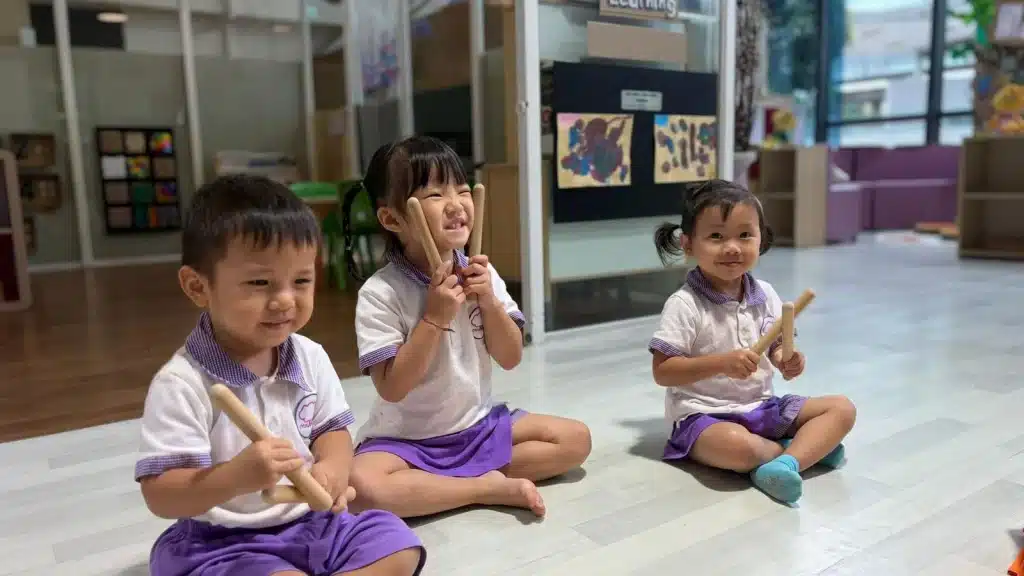
The short answer: The right preschool is the one that fits your child, not the one at the top of a list. Compare centres on five things: the learning approach, the educators, the learning environment, your daily commute, and your net monthly fee after government subsidies. Then visit your top two or three during a regular school day.
In this guide:
- Narrowing down the preschools near you
- Types of preschools in Bishan
- Curriculum approaches compared, and how we bring Reggio Emilia to life
- Habits of Mind™: why thinking habits matter as much as ABCs
- What preschool looks like at each age
- Preschool fees in Bishan for 2026
- Subsidies: what you will really pay
- What to look for on a school tour
- Why parents choose Mulberry Learning @ Bishan
- Frequently asked questions
- Your next steps
Narrowing down the preschools near you
Most Bishan families start with a map, not a ranking. Before comparing curricula, decide where the preschool needs to be, because that alone can cut a long list down to a handful.
Near home, near work, or on the way?
| Option | Works well when | Watch out for |
|---|---|---|
| Near home | A grandparent or helper does pick-up; you want your child's preschool friends to live nearby | Getting there quickly from work if your child falls ill |
| Near work | You want to reach your child quickly during the day | A longer daily journey for your child, and friends who live elsewhere |
| On the way | You pass a centre on your route to the MRT or office | Whether drop-off still works on days your routine changes |
Whichever you pick, try the journey at drop-off time, ideally on a rainy morning, before you decide.
Know your corner of Bishan
Preschools in the area broadly fall into three pockets:
- Around Bishan MRT and the town centre: convenient for North-South and Circle Line commuters, and the busiest area at peak hours
- The HDB estates of Bishan North and Bishan East: many centres sit at the foot of residential blocks, within a short walk of home
- Marymount, Sin Ming and Jalan Pemimpin: served by Marymount MRT on the Circle Line, with a mix of homes, offices and purpose-built centres
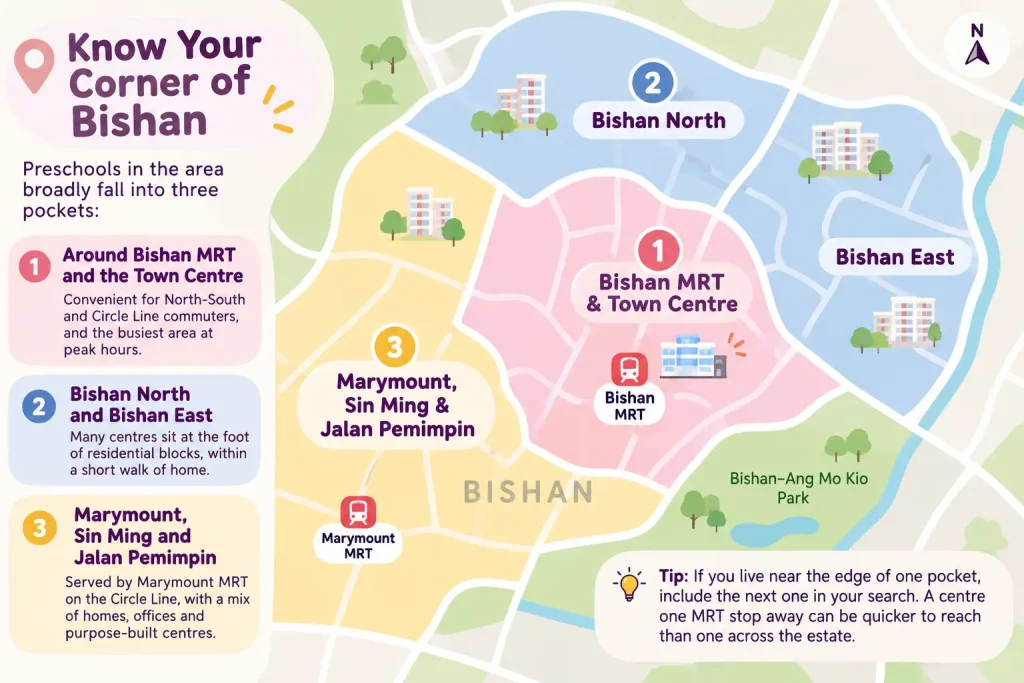
If you live near the edge of one pocket, include the next one in your search. A centre one MRT stop away can be quicker to reach than one across the estate.
Think about the next few years
- Staying put or moving? A centre that runs from playgroup to K2 only helps if you will still live nearby.
- Brothers and sisters: if you plan another child, check whether the centre or a nearby one offers infant care.
- Primary 1: home-school distance can affect your child’s priority for some primary schools, so it helps to understand the rules early. The MOE Primary 1 registration pages explain how it works.
Types of preschools you will find in Bishan
Every preschool and childcare centre in Singapore must be licensed by the Early Childhood Development Agency (ECDA). Beyond that, centres fall into a few broad types, and the type affects fees, class sizes and curriculum.
| Type | How it works | Full-day childcare fee (2026, before GST) |
|---|---|---|
| Anchor Operator (AOP) | Large operators that receive the most government funding, in return for capped fees | Capped at S$610 a month |
| Partner Operator (POP) | Smaller chains and independent centres in a government partnership scheme, also fee-capped | Capped at S$650 a month |
| Private preschools | Independent operators that set their own fees, often with a proprietary curriculum, specialist programmes or purpose-designed spaces | Set by each centre |
| Kindergartens | Half-day programmes for K1 and K2, including MOE Kindergartens | Varies; usually lower because hours are shorter |
Fee caps apply to Singapore Citizen children. Sources: ECDA via ask.gov.sg (AOP caps, POP caps).
There is no single “best” type. Government-supported centres keep costs predictable. Private centres usually cost more, and parents choosing them are typically paying for a particular curriculum, a smaller or more specialised setting, or extra programmes.
Whichever type you consider, check that the centre is ECDA-licensed and ask whether it holds SPARK certification, ECDA’s quality-assurance framework for preschools.
Curriculum approaches: which suits your child?
Preschool websites are full of labels like “play-based”, “inquiry-led” and “holistic”. In practice, most centres blend several approaches. This table shows what each one usually looks like day to day.
| Approaches | What a typical day looks like | Often suits children who | What to look for on a tour |
|---|---|---|---|
| Play-based | Free and guided play are the main way children learn: maths through blocks, language through stories and role play | Learn by doing and need movement | Whether play has clear learning goals behind it |
| Montessori | Children choose from specially designed materials and work at their own pace, often in mixed-age groups | Like order, independence and focused work | Trained Montessori educators and a full set of materials |
| Reggio Emilia-inspired | Children explore topics in depth through long projects, guided by their own questions; work is documented on the walls | Are curious, ask lots of questions, enjoy creating | Project documentation, open-ended materials, studios |
| Structured or academic | Teacher-led lessons in literacy, numeracy and languages, on a set timetable | Thrive on routine and clear steps | Balance between desk work and play |
| Bilingual immersion | Children hear and use English and a Mother Tongue language every day, not only in a weekly class | Will need strong Mother Tongue skills for Primary school | How much of the day is in each language |
What a Reggio Emilia classroom actually looks like
The Reggio Emilia approach began in the Italian town of the same name after the Second World War. It treats children as capable learners with their own ideas and treats the classroom environment as a teacher in its own right.
On a tour, you would typically notice:
- Children’s work on display, with their words beside it. Educators record what children said and did, so learning is visible to parents.
- Long projects instead of one-off worksheets. A question about rain might become weeks of observing, drawing, building and measuring.
- Studios and natural, open-ended materials. Clay, light tables, loose parts and art materials, rather than only plastic toys.
- Educators who ask more than they tell. Expect to hear “What do you think will happen?” more often than direct answers.

How we bring Reggio Emilia to life at Mulberry Learning
We chose a Reggio-inspired approach because we believe young children learn best when they are treated as capable explorers, not passive listeners. To a child, every minute is a chance to discover something new. Our role is to give that curiosity room to grow, then guide it towards real learning.
The environment as the “third teacher”
In the Reggio Emilia approach, the classroom itself teaches, alongside educators and parents. That is why our spaces are designed with as much care as our lessons. At our Bishan centre, that means bright, open-concept learning studios and an outdoor play compound where learning continues beyond the classroom.
Signature learning corners
Across Mulberry Learning centres, children move between signature learning corners, each designed to build different skills through play:
| Learning corner | What children do there | What it builds |
|---|---|---|
| The Busy Baker™ | Measure, mix and bake simple recipes | Early maths, following steps, patience |
| Discovery Cove™ | Observe, test and investigate everyday materials | Scientific thinking and questioning |
| Art Atelier™ | Paint, sculpt and create with open-ended materials | Creativity and self-expression |
| Construction Piazza™ | Design and build structures, alone and in teams | Problem-solving and teamwork |
| Imaginary Playscape™ | Role-play everyday and imagined worlds | Language, empathy and social skills |
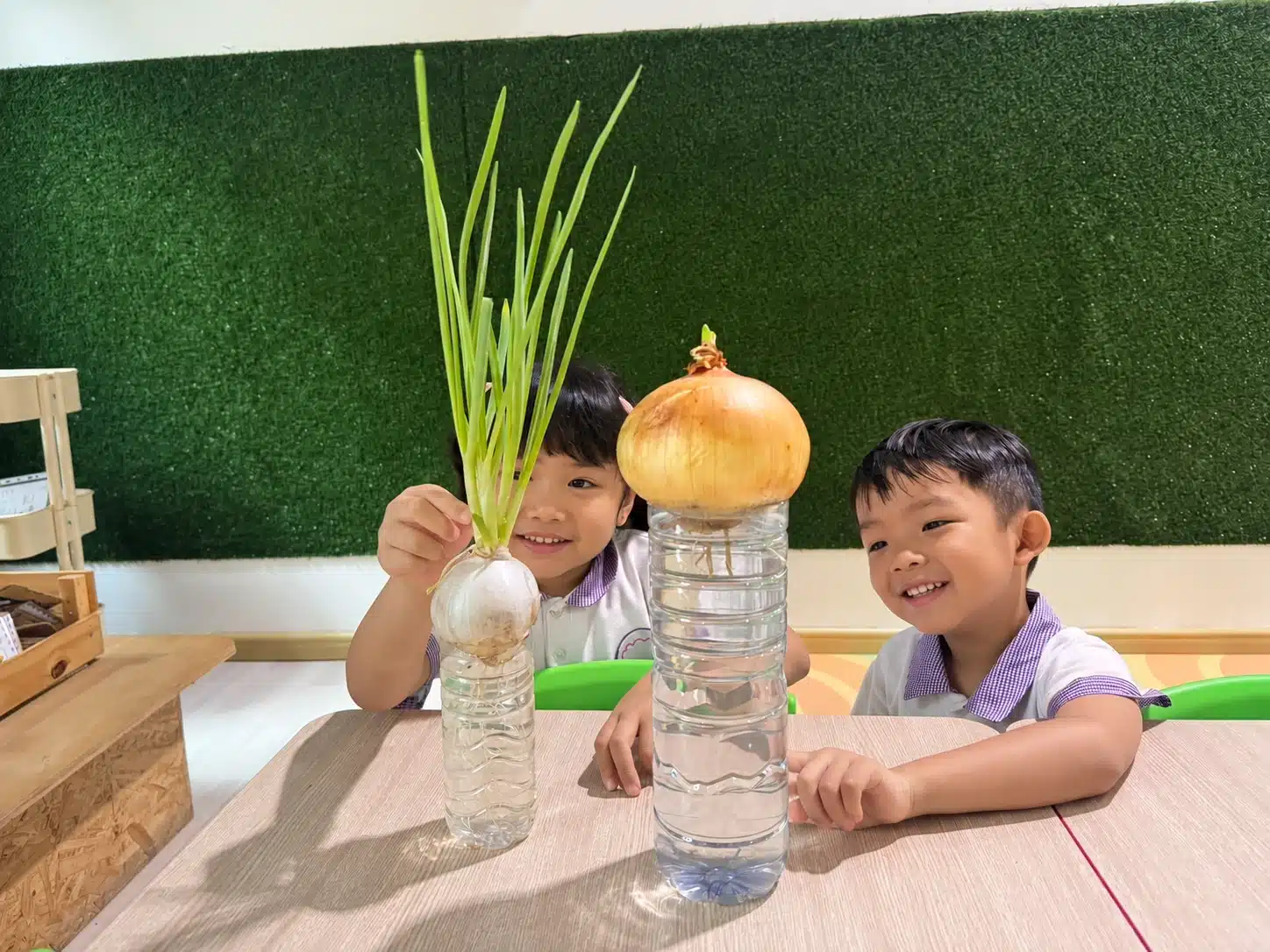
Project Inquiry™ @ Mulberry Learning: children as little scientists
Our signature Project Inquiry™ @ Mulberry Learning runs over six months. Children choose a topic that fascinates them and investigate it in small groups using the KWL framework:
- Know: What do we already know?
- Want: What do we want to find out?
- Learn: What did we learn?
Along the way, children research, experiment and record their findings in English and Mandarin. The journey ends with a project presentation to parents, where children share what they discovered with confidence and pride.
Our four-pillar curriculum model
Everything children do at Mulberry Learning fits into four connected strands:
| Strand | Focus |
|---|---|
| iLearn | Structured, progressive lessons towards competency in English and numeracy |
| iExplore | Learning through project inquiry and teamwork |
| iExperience | Building confidence through self-directed learning, games and exploration |
| iDevelop | Developing multiple intelligences through varied programmes |
Source: Mulberry Learning @ Bishan curriculum, Mulberry Learning Programmes
Habits of Mind™: why thinking habits matter as much as ABCs
Watch how your child reacts when something is hard. Do they cry, give up, or look for another way? Those small moments are early signs of how they will handle challenges later, in Primary school and in life. Habits of Mind™ is how we help children build the right responses, on purpose.
Introduction to Habits of Mind™
Habits of Mind™ is a framework developed by educators Dr Arthur Costa and Dr Bena Kallick. It describes 16 thinking habits that people use when they face a problem they cannot solve straight away. In short, it is about knowing how to behave intelligently when the answer is not obvious.
At Mulberry Learning, we have selected the 12 habits most meaningful for young children and woven them into our daily curriculum:
| Habit | What it looks like in a preschooler |
|---|---|
| Persisting | Trying again when the block tower falls, instead of saying “I can’t” |
| Managing Impulsivity | Waiting for a turn, or thinking before grabbing a toy |
| Listening with Understanding and Empathy | Noticing a friend is sad and asking why |
| Thinking Flexibly | Trying a new way when the first idea does not work |
| Thinking About Your Thinking | Explaining how they solved a puzzle |
| Striving for Accuracy | Checking their work and taking pride in it |
| Questioning and Posing Problems | Asking “why” and “what if” |
| Applying Past Knowledge to New Situations | Remembering how they solved something similar before |
| Gathering Data through All Senses | Touching, smelling and listening to learn about something new |
| Creating, Imagining, Innovating | Inventing a new game or story |
| Finding Humour | Laughing at a funny mistake and trying again |
| Thinking Interdependently | Building something together with friends |
Why it matters for your child
Most parents know that success depends on more than knowing facts. It also depends on how a child learns: asking good questions, sticking with hard tasks, thinking flexibly and working well with others. These skills usually develop through years of trial and error, if they develop at all.
Habits of Mind™ gives children a structured, deliberate way to build them from the start. For parents, that can mean:
- A smoother start to Primary 1: persisting, managing impulses and asking for help are exactly what children need for a bigger class and more independent work.
- More resilience: children learn that “I can’t do it yet” is the start of trying, not the end.
- Better relationships: listening with empathy and thinking interdependently help children make and keep friends.
- Skills for an uncertain future: the world your child will grow up in will keep changing. The ability to think flexibly and solve new problems will matter long after any single fact is forgotten.
The same framework is used in the Ministry of Education’s Gifted Education Programme. We believe these habits should not be reserved for a few older students, so we start building them from preschool.
How we teach it at Mulberry Learning
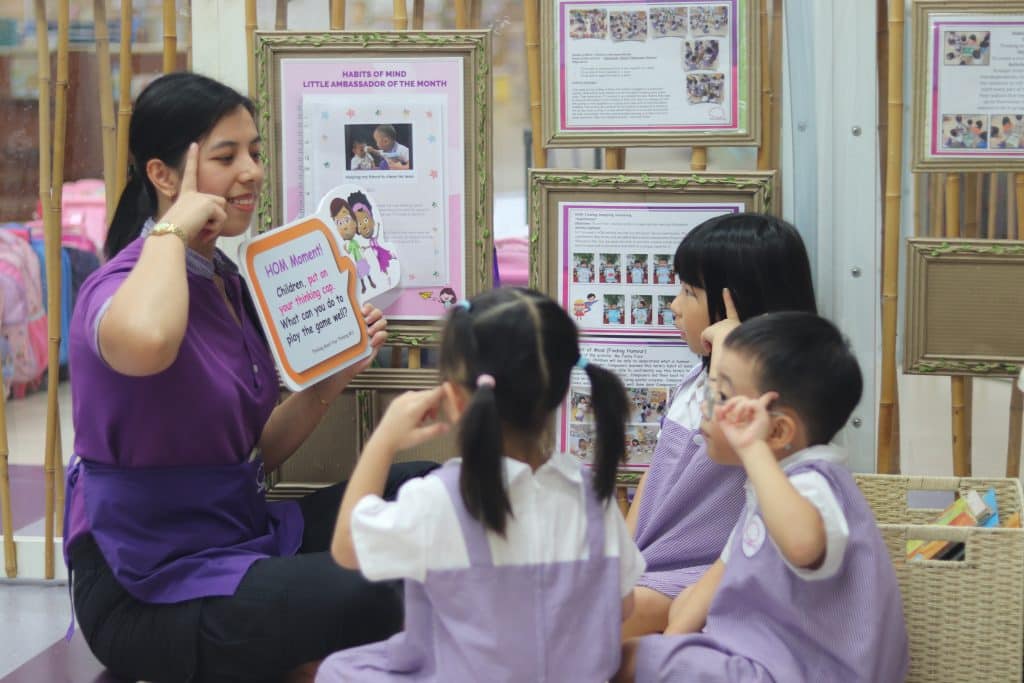
- A new habit each month: educators introduce each habit through specially designed lessons, with catchy slogans that young children can remember.
- Reinforced every day: educators revisit the habit in teachable moments throughout the day, during lessons, play, mealtimes and wash-up.
- Built into the environment: Habits of Mind™ posters fill our centres, and educators model the habits themselves.
- Celebrated: each month, we recognise HOM Little Ambassadors who show the habits at school and at home.
- Shared with parents: we update you on how your child is showing each habit, and run parent workshops with ideas to reinforce them at home.
Mulberry Learning is Singapore’s only preschool network certified by The Institute for Habits of Mind™ (USA).
How you will see your child’s progress
Thinking habits are harder to measure than reading or counting. So we developed THOMAS, The Habits of Mind™ Assessment Tool, created by our Research and Curriculum Dean, Dr Henry Toi, an affiliate of The Institute for Habits of Mind™.
Educators complete THOMAS with input from parents, based on what they observe at school and at home. The report gives you a clear picture of how your child’s thinking habits are growing, and helps us keep improving our curriculum.
Try it at home
You can reinforce the same habits with a few simple questions:
- “Have you seen a problem like this before? What did you do then?” (Applying Past Knowledge)
- “What else could you try?” (Thinking Flexibly)
- “How did you figure that out?” (Thinking About Your Thinking)
- “How do you think your friend felt?” (Listening with Understanding and Empathy)
Source: Mulberry Learning: Intelligent Thinking Through Habits of Mind, Mulberry Learning @ Bishan curriculum.
What preschool looks like at each age
In Singapore, preschool levels are usually grouped by the year your child turns a certain age. Names vary slightly between centres, but the stages are broadly the same.

Playgroup or Pre-Nursery (18 months to about 3 years)
This stage is about settling in, building trust with educators and learning daily routines such as meals, naps and handwashing. Language grows quickly, so look for educators who talk, sing and read with children throughout the day.
Ask: How do you help a child settle in during the first few weeks? What is the educator-to-child ratio?
Nursery 1 and Nursery 2 (3 and 4 years)
Children become more social and independent. They start to play cooperatively, follow simple group activities and express themselves in longer sentences, in both English and their Mother Tongue.
Ask: How do you support children who are shy or still learning to share? How is the Mother Tongue language taught?
Kindergarten 1 and Kindergarten 2 (5 and 6 years)
The focus turns to readiness for Primary 1. This means early reading and writing, number sense, and just as importantly, independence, focus and the confidence to ask for help.
Ask: What does your K2 programme do to prepare children for Primary 1, beyond academics? How do you share a child’s progress with parents?
Tip: Choosing one centre that runs all the way from playgroup to K2 can spare your child a change of school before Primary 1. If you start at a centre that ends earlier, plan the move in advance.
Preschool fees in Bishan for 2026
The published monthly fee is only the starting point. To compare centres fairly, ask each one for a written fee schedule that shows every item below.
What makes up a preschool fee
- Monthly fee: usually quoted per month, for full-day (typically 7am to 7pm) or half-day sessions
- GST: fee caps and many quoted fees exclude GST, so check whether 9% GST is added
- One-time costs: registration fee, a refundable deposit, insurance and uniforms
- What is included: meals and snacks, enrichment programmes, excursions and learning materials may be included or charged separately
- Annual adjustments: ask when fees were last revised and how much notice is given for changes
What to expect by type of preschool
From 1 January 2026, full-day childcare fees for Singapore Citizen children are capped at S$610 a month at Anchor Operator centres and S$650 a month at Partner Operator centres, before GST (ECDA: AOP caps, POP caps).
Private preschools set their own fees, which vary widely depending on the programme, facilities and location. Comparing the net fee after subsidies, not the headline price, gives a truer picture. The next section shows how to work that out.
Subsidies: how to work out what you will really pay
For a Singapore Citizen child in full-day childcare at an ECDA-licensed centre, government subsidies can reduce your monthly fee by up to S$767. There are two parts.
Basic Subsidy
Every Singapore Citizen child in an ECDA-licensed centre qualifies, regardless of income. For full-day childcare, it is S$300 a month if the main applicant works at least 56 hours a month, and S$150 a month if not (ECDA).
Additional Subsidy
Working families can receive more, based on gross monthly household income. ECDA is raising the income bands from 1 January 2027, so more families will qualify. If your child starts in 2027, use the 2027 column.
| Max Additional Subsidy (full-day childcare) | Household income, 2026 | Household income, from 1 Jan 2027 |
|---|---|---|
| None | Above S$12,000 | Above S$15,000 |
| S$467 | S$3,000 and below | S$3,500 and below |
| S$440 | S$3,001 to S$4,500 | S$3,501 to S$5,500 |
| S$340 | S$4,501 to S$6,000 | S$5,501 to S$7,500 |
| S$260 | S$6,001 to S$7,500 | S$7,501 to S$9,000 |
| S$190 | S$7,501 to S$9,000 | S$9,001 to S$11,000 |
| S$130 | S$9,001 to S$10,500 | S$11,001 to S$13,000 |
| S$80 | S$10,501 to S$12,000 | S$13,001 to S$15,000 |
Source: ECDA subsidy table, updated 6 October 2026. Larger households may qualify through the per-capita income test instead; the table shows both.
A worked example
A working couple earning S$8,000 a month in total enrol their daughter in full-day childcare in January 2027.
- Basic Subsidy: S$300
- Additional Subsidy (S$7,501 to S$9,000 band, 2027): S$260
- Total subsidy: S$560 a month
If the centre’s monthly fee were S$1,800 (an illustrative figure, not any specific centre’s fee), the family would pay about S$1,240 a month after subsidies. Your exact amount is confirmed by ECDA when your application is processed.
How to check your own amount
Use ECDA’s official subsidy calculator with your household income and the centre’s fee. When you enrol, the centre will guide you through the subsidy application. Permanent Resident children receive lower subsidies, so check the calculator for your situation.
What to look for on a school tour
A school tour offers valuable insights that go beyond what any website or brochure can tell you. Whenever possible, visit during a regular school day to observe classroom interactions, daily routines and the overall learning environment.
To help you make an informed decision, we’ve put together a 20-Question School Tour Checklist, covering essential questions to ask and key things to look out for during your visit.
Use it to compare preschools, evaluate your options and find the best fit for your child.
Why parents choose Mulberry Learning @ Bishan
Why we do what we do
Since 2006, Mulberry Learning has been built on one belief: preschool should prepare children for life, not just for Primary 1. Reading, writing and counting matter, and we teach them carefully. But we believe the habits a child forms, how they think, try, listen and recover from mistakes, shape their future just as much.
That is why our curriculum brings together three approaches: Reggio Emilia, so children learn through curiosity and discovery; Habits of Mind™, so they build the thinking habits to handle challenges; and Multiple Intelligences, so every child can learn in the ways that suit them. Our aim is for every child to grow into a competent explorer, an imaginative thinker and a creative problem solver.
Six reasons families in Bishan choose us
- A curriculum that builds thinking, not just knowledge: Reggio-inspired learning combined with Habits of Mind™, from playgroup to K2.
- Progress you can see: THOMAS reports on your child’s thinking habits, alongside regular updates, photos and termly parent-teacher conferences.
- Bilingual every day: children learn in English and Mandarin daily, through Literacy Fun™ and Chinese Master™.
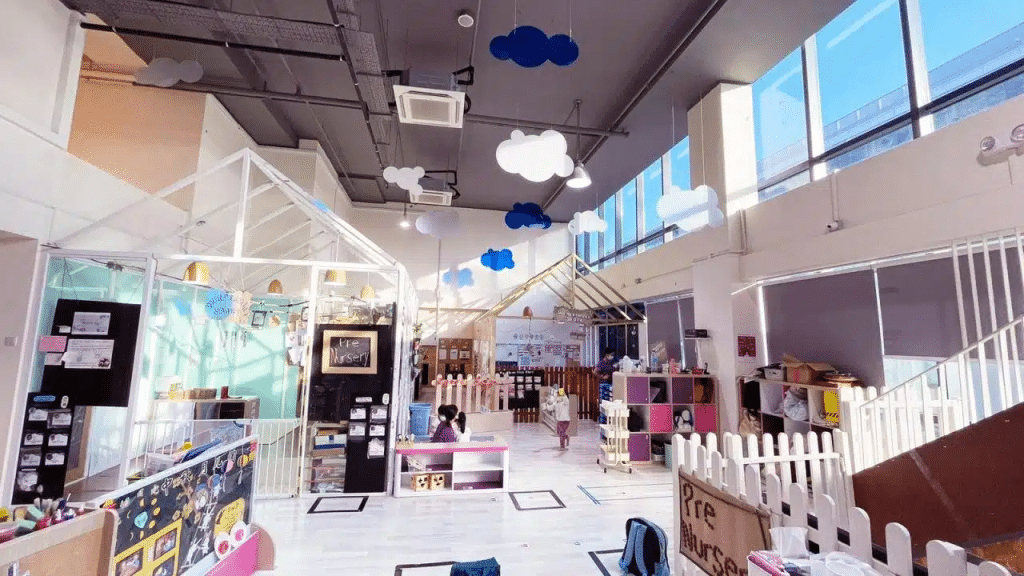
- Spaces designed to inspire: around 5,000 sqft with 6-metre windows, learning studios, an outdoor play compound and a rooftop pool in the same building.
- Educators who know each child: more than 250 hours of training each, with ratios from 1:6 in playgroup.
- Easy to reach: about a 4-minute walk from Marymount MRT, open 7am to 7pm on weekdays.
Here is a closer look at our Bishan centre.

A space designed for exploring
Our Bishan centre spans around 5,000 sqft, with an open-concept layout and 6-metre floor-to-ceiling windows that fill the classrooms with natural light. In line with the Reggio Emilia approach, children learn in dedicated learning studios designed to spark their senses and curiosity.
Learning continues outdoors in our own outdoor play compound, where children explore, play and build motor skills under the eye of their educators. The building also has a rooftop swimming pool, so we can offer a swimming programme with qualified coaches as part of our enrichment, without leaving the building.
Our programmes
Alongside Reggio-inspired projects and Habits of Mind™, children follow a well-paced, bilingual curriculum matched to their stage of development.
| Programme | What it covers |
|---|---|
| STEAM enrichment | Busy Baker™, Picasso Kidz™, Music Mooves™, Little Newton™ and Kids Can Do™, with exposure to music, art, movement and creative expression |
| Bilingual immersion | English and Mandarin every day, through storytelling, songs and themed learning |
| Literacy Fun™ | English phonics, reading and storytelling through sensory, hands-on activities |
| Swimming | Lessons with qualified coaches in the rooftop pool of our building |
| Math Quest™ | Logical thinking and problem-solving through practical activities |
| Chinese Master™ | Mandarin listening, speaking and reading through play and stories |
Beyond the Classroom: Swimming Enrichment
At Mulberry Learning @ Bishan, learning goes beyond the classroom! In collaboration with Ace Dolphin Swim School, we offer swimming enrichment conveniently conducted within our school building.

Led by experienced coaches, our 45-minute, play-based lessons help children develop water confidence, essential swimming skills and independence at their own pace. Through engaging activities and progressive milestones aligned with the SwimSafer 2.0 framework, children build confidence in the water while having fun.
Educators who know each child
In Singapore, the Early Childhood Development Agency (ECDA) sets minimum staff-child ratio requirements across different age groups to ensure children receive appropriate care, guidance and supervision throughout their early years.
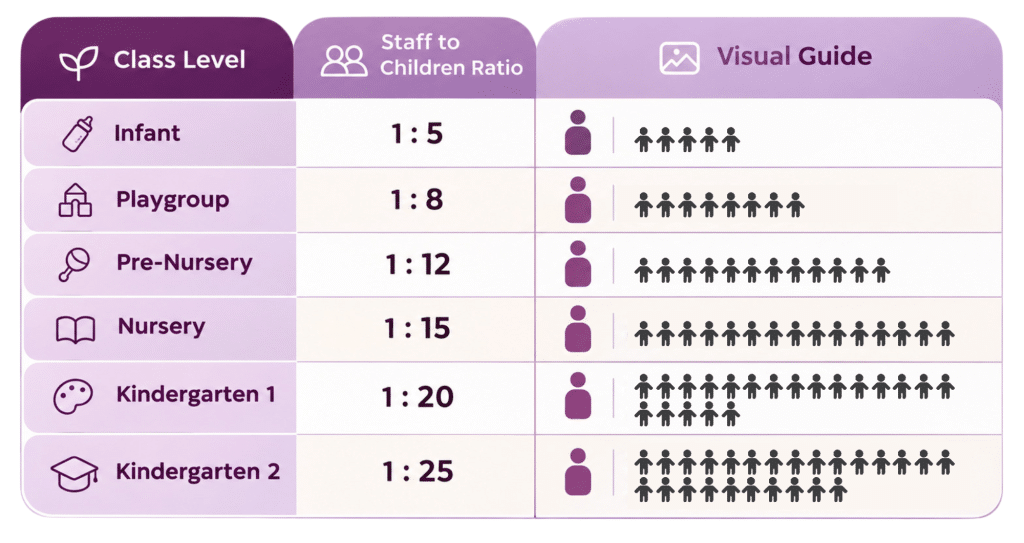
Source: ECDA minimum staff-child ratios.
At Mulberry Learning, we recognise that meaningful learning begins with personal attention. Beyond meeting regulatory requirements, we are committed to creating a nurturing environment where every child feels seen, heard and supported.
How do our educator-to-child ratios compare with ECDA’s requirements?
| Level | Age | Ratio |
|---|---|---|
| Pre-Nursery | 18 to 30 months | 1 : 6 |
| Nursery 1 | 3 years | 1 : 8 |
| Nursery 2 | 4 years | 1 : 10 |
| Kindergarten 1 | 5 years | 1 : 12 |
| Kindergarten 2 | 6 years | 1 : 15 |
Our commitment goes beyond numbers. Every Mulberry Learning educator completes over 250 hours of training, with continuous professional development guided by our proprietary i-Inspire™ Educator Growth Model. This equips our educators with the skills to understand each child’s unique strengths, learning needs and developmental milestones.
We also believe in keeping parents closely involved in their child’s learning journey. Through our secure parent app, families receive regular updates, photos and progress notes, complemented by termly parent-teacher conferences to discuss their child’s growth and development.

What parents say
“The teachers take the time to get to know every child individually, and you can see the warmth and dedication in the way they interact with the kids. Pickup time always comes with a cheerful update on how our little one’s day went, which gives us so much peace of mind as working parents.”
— HY, Mulberry Learning @ Bishan
“Having my child enrolled at Mulberry Learning has been a great experience for them. They get the most attention and care out of all the schools they’ve been enrolled at. The teachers and administration have been very communicative and caring regarding my child and their development.”
— MT, Mulberry Learning @ Bishan
Visit us
- Address: 38 Jalan Pemimpin, #01-05/06 M38, Singapore 577178
- Hours: Monday to Friday, 7am to 7pm
- Programmes: Full-day and half-day, 18 months to 6 years
- Phone / WhatsApp: +65 8244 0522
Getting here
| From | On foot | By car |
|---|---|---|
| Marymount MRT (Circle Line) | About 4 minutes, 260 m | About 2 minutes, 450 m |
| Bishan MRT (North-South and Circle lines) | About 12 minutes, 950 m | About 3 minutes, 1.3 km |
Frequently asked questions
What is the best preschool in Bishan?
There is no single best preschool for every child. The right choice depends on your child’s personality, the learning approach you value, your commute and your budget after subsidies. Shortlist two or three centres that fit, then visit each during a regular school day and use a checklist to compare them.
How much does preschool cost in Bishan in 2026?
Full-day childcare is capped at S$610 a month at Anchor Operator centres and S$650 at Partner Operator centres, before GST, for Singapore Citizen children. Private preschools set their own fees. Government subsidies of up to S$767 a month can reduce what you pay, so compare net fees rather than headline prices.
How much childcare subsidy can I get?
For full-day childcare, a Singapore Citizen child gets a Basic Subsidy of S$300 a month if the main applicant works at least 56 hours a month. Working families may also receive up to S$467 a month in Additional Subsidy, depending on household income. ECDA’s online calculator gives your exact estimate.
Is there a preschool near Marymount MRT?
Yes. The Marymount side of Bishan, around Jalan Pemimpin and Sin Ming, has several preschools within walking distance of Marymount MRT on the Circle Line. Mulberry Learning @ Bishan, at M38 on Jalan Pemimpin, is about a 4-minute walk from the station.
What age can my child start preschool in Singapore?
Childcare centres in Singapore accept children from 18 months, usually in a playgroup or pre-nursery class. Many centres also offer infant care from 2 months. Children then move through Nursery 1 and 2 and Kindergarten 1 and 2 before starting Primary 1 in the year they turn seven.
What is a Reggio Emilia preschool?
A Reggio Emilia-inspired preschool lets children explore topics in depth through projects shaped by their own questions. Educators document what children say and create, and the classroom environment is carefully designed to encourage curiosity. On a visit, look for children’s work on display, studios and open-ended natural materials.
What is Habits of Mind™ and how is it taught to young children?
Habits of Mind™ is a framework of thinking habits, such as persisting, thinking flexibly and managing impulsivity, developed by educators Arthur Costa and Bena Kallick. In preschool, educators build these habits into everyday play and projects, for example by encouraging a child to keep trying, and explain what they will do differently. At Mulberry Learning, we teach 12 of these habits, introducing a new one each month, and track progress with our THOMAS assessment.
Should I choose full-day or half-day preschool?
Full-day programmes, usually 7am to 7pm, suit families where both parents work. Half-day programmes run for a few hours and suit families with a caregiver at home in the afternoon. Subsidies are higher for full-day childcare, so compare the net cost of each option.
When should I register for preschool?
Register as early as you can, ideally several months before your intended start date. Places are limited by class size, and popular levels and centres can fill up or keep waitlists. Visiting early also gives you time to compare centres without pressure.
What should I ask on a preschool tour?
Ask about educator training and turnover, educator-to-child ratios, the daily routine, outdoor time, how Mother Tongue is taught, how progress is shared with parents, and exactly what the fee includes. Use our 20-question checklist above to compare centres consistently.
How do preschools prepare children for Primary 1?
Good K2 programmes build early reading, writing and number skills, but also independence, focus and confidence. Ask how the centre helps children manage their own belongings, follow instructions in a larger group and handle new situations, as these matter just as much in the first weeks of Primary 1.
Why choose Mulberry Learning @ Bishan?
Mulberry Learning @ Bishan combines a Reggio Emilia-inspired approach with Habits of Mind™, so children build thinking habits such as persistence and flexible thinking alongside literacy, numeracy and bilingual skills. Families also choose us for our purpose-designed 5,000 sqft centre, trained educators and location near Marymount MRT.
How do I book a tour at Mulberry Learning @ Bishan?
You can book a school tour online or WhatsApp the centre on +65 8244 0522. The centre is open Monday to Friday, 7am to 7pm, at 38 Jalan Pemimpin, #01-05/06 M38, a short walk from Marymount MRT.
Your next steps
- Shortlist two or three centres that fit your child, your preferred learning approach and your daily commute.
- Work out your net fee for each one using ECDA’s subsidy calculator.
- Visit during a regular school day and take the 20-question checklist with you.
If you are considering the Marymount side of Bishan, we would love to show you around. Come and see our learning studios and outdoor compound, meet our educators, and ask us anything on your list.

Sources
- ECDA subsidy table for childcare and infant care, updated 6 October 2026
- ECDA: Who is eligible for Basic and Additional Subsidies?
- ECDA: Anchor Operator fee caps
- ECDA: Partner Operator fee caps from 1 Jan 2026
- ECDA subsidy calculator
- MOE Primary 1 registration
- Mulberry Learning @ Bishan centre page
- Mulberry Learning @ Bishan microsite